DAGGER: Distractor-Aware Graph Generation for Executable Reasoning in Math Problems
Key Results
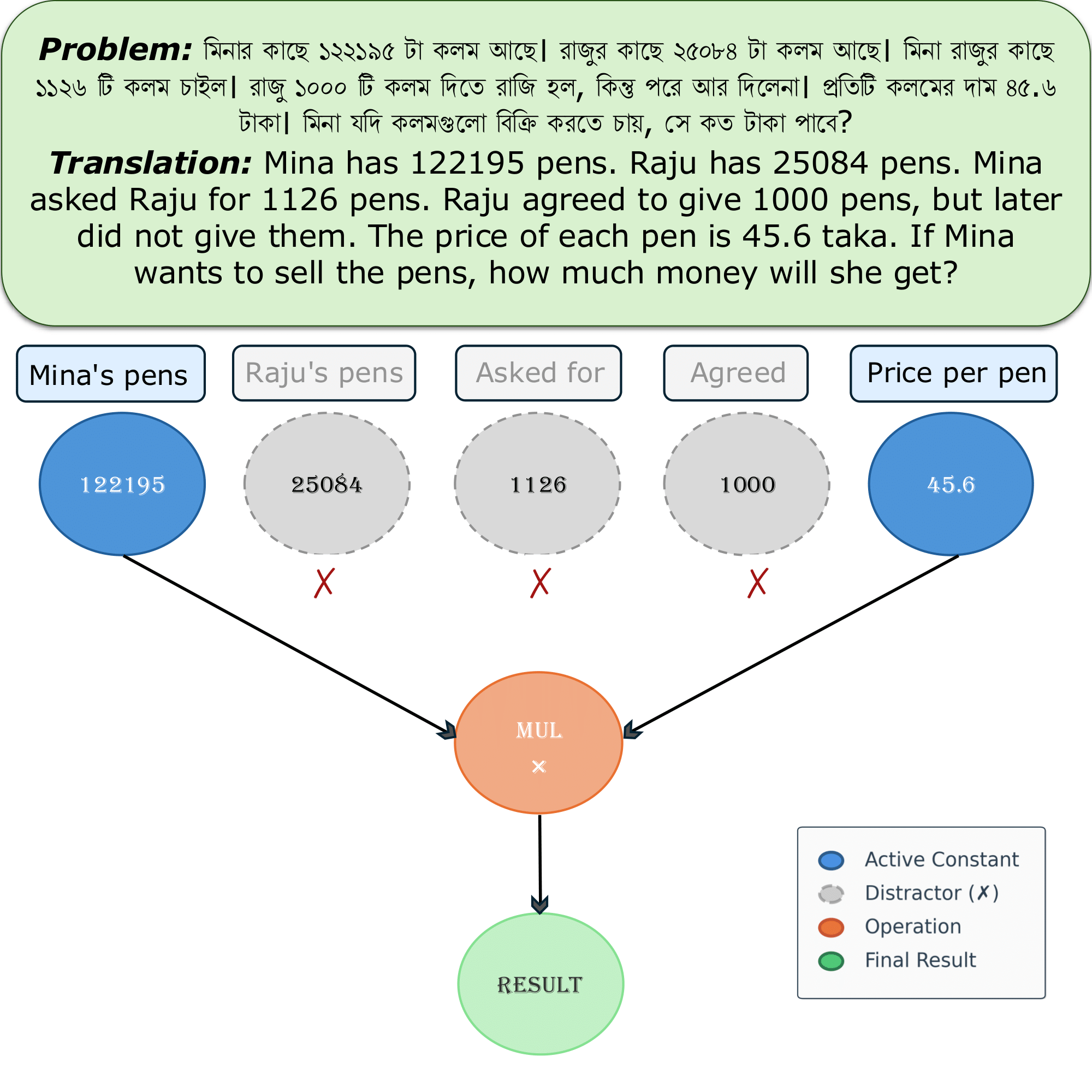
Overview: DAGGER reformulates math word problems as executable computational graphs. Each node represents an operation or value, with explicit distractor: true/false annotations to identify irrelevant information.
Abstract
Chain-of-Thought (CoT) prompting is widely adopted for mathematical problem solving, including in low-resource languages, yet its behavior under irrelevant context remains underexplored. We introduce DistractMath-BN, a Bangla benchmark that augments MGSM and MSVAMP with semantically coherent but computationally irrelevant information.
Evaluating seven models (3B-12B parameters), we observe substantial performance degradation under distractors: standard models drop up to 41 points, while reasoning-specialized models decline 14-20 points despite consuming 5x more tokens.
We propose DAGGER (Distractor-Aware Graph Generation for Executable Reasoning), which reformulates mathematical problem solving as executable computational graph generation with dedicated modeling of distractor nodes. Fine-tuning Gemma-3 models using SFT followed by GRPO achieves comparable weighted accuracy on augmented benchmarks while using 89% fewer tokens than reasoning models. Importantly, this robustness emerges without explicit training on distractor-augmented examples.
The Problem: Distractors Break Mathematical Reasoning
We identify three types of distractors that cause significant performance degradation in LLMs:
RED Related Entity Distractor
Numerical info about same object type but different entities
"তার বোন বুধবার ১২ জন ছেলেমেয়ের সঙ্গে লুকোচুরি খেলেছিল।"
"Her sister played hide-and-seek with 12 children on Wednesday."
OAD Orthogonal Attribute Distractor
Properties in different dimensions than queried attribute
"সোমবার খেলতে ১ ঘণ্টা সময় লেগেছিল।"
"It took 1 hour to play on Monday." (when question asks about count)
NEED Null-Effect Event Distractor
Actions with zero net impact (planned but not executed)
"রাজু ১০০০ টি দিতে রাজি হল, কিন্তু পরে আর দিলনা।"
"Raju agreed to give 1000, but later didn't."
Performance Degradation Under Distractors
Standard CoT models drop up to 41 points accuracy. Even reasoning models with 5x more tokens drop 14-20 points.
Our Solution: Computational Graph Generation
Why Graphs?
Instead of free-form Chain-of-Thought reasoning, DAGGER generates structured computational graphs:
distractor field to mark irrelevant information
Graph Example
{
  "nodes": [
    {"id": "n1", "op": "const", "val": 100,
     "distractor": false, "label": "মিনার কলম"},
    {"id": "n2", "op": "const", "val": 50,
     "distractor": true, "label": "রাজুর কলম"},
    {"id": "n3", "op": "const", "val": 5,
     "distractor": false, "label": "কলমের দাম"},
    {"id": "total", "op": "mul",
     "args": ["n1", "n3"], "distractor": false},
    {"id": "final_result", "op": "identity",
     "args": ["total"], "distractor": false}
  ]
}
Node n2 (Raju's pens) is marked as distractor and excluded from computation path.
Training Pipeline: SFT + GRPO
Stage 1: Supervised Fine-Tuning (SFT)
- Train on 3,000 verified graph examples
- LoRA rank 64, 4 epochs
- Establishes graph generation capability
Stage 2: Group Relative Policy Optimization (GRPO)
- 8 generations per prompt
- Multi-component reward:
- Format: +0.5 for valid JSON
- Execution: +0.5 for successful run
- Accuracy: +1.0 for correct answer
Key Finding: SFT initialization is critical for smaller models. 4B models without SFT show +18 point improvement when SFT is added before GRPO.
Results
Main Comparison
DAGGER achieves comparable accuracy to reasoning models while using 89% fewer tokens:
| Model | MGSM | MSVAMP | MGSM (+D) | MSVAMP (+D) | Tokens |
|---|---|---|---|---|---|
| Qwen 3-8B (Reasoning) | 88.0 | 81.1 | 70.5 | 66.9 | 3,128 |
| Gemma 3-12B (CoT) | 76.8 | 72.3 | 54.3 | 48.7 | 599 |
| DAGGER-12B Ours | 78.4 | 78.8 | 64.0 | 66.8 | 359 |
(+D) = with distractors
Model Zoo
All models available on HuggingFace:
| Model | Training | MGSM | MSVAMP | MGSM (+D) | MSVAMP (+D) | Weighted Avg |
|---|---|---|---|---|---|---|
| dagger-12B_SFT_GRPO Best | SFT → GRPO | 78.4 | 78.8 | 64.0 | 66.8 | 69.4 |
| dagger-12B_SFT | SFT only | 70.0 | 76.8 | 56.8 | 65.4 | 66.7 |
| dagger-12B_GRPO | Base → GRPO | 67.6 | 75.0 | 48.4 | 59.6 | 61.5 |
| dagger-4B_SFT_GRPO | SFT → GRPO | 54.8 | 70.3 | 31.4 | 42.9 | 47.3 |
| dagger-4B_SFT | SFT only | 40.4 | 65.0 | 25.1 | 42.4 | 44.3 |
| dagger-4B_GRPO | Base → GRPO | 29.2 | 57.1 | 13.1 | 29.3 | 32.5 |
Datasets
DistractMath-BN (Evaluation)
Distractor-augmented benchmark for evaluating robustness
DAGGER Training Data
Verified computational graph annotations for training
BibTeX
@inproceedings{nazi2026dagger,
  title={{\dag}DAGGER: Distractor-Aware Graph Generation for Executable Reasoning in Math Problems},
  author={Zabir Al Nazi and Shubhashis Roy Dipta and Sudipta Kar},
  booktitle={Findings of the Association for Computational Linguistics: EMNLP 2026},
  year={2026},
  eprint={2601.06853},
  archivePrefix={arXiv},
  primaryClass={cs.CL},
  url={https://arxiv.org/abs/2601.06853},
}